“All Scripture is God-breathed and is useful for instruction, for conviction, for correction, and for training in righteousness.” 2 Tim 3:16
1 Kings 22:2-50; 2 Kings 3:1-27; 2 Chron 17-20
Who Was King Jehoshaphat?
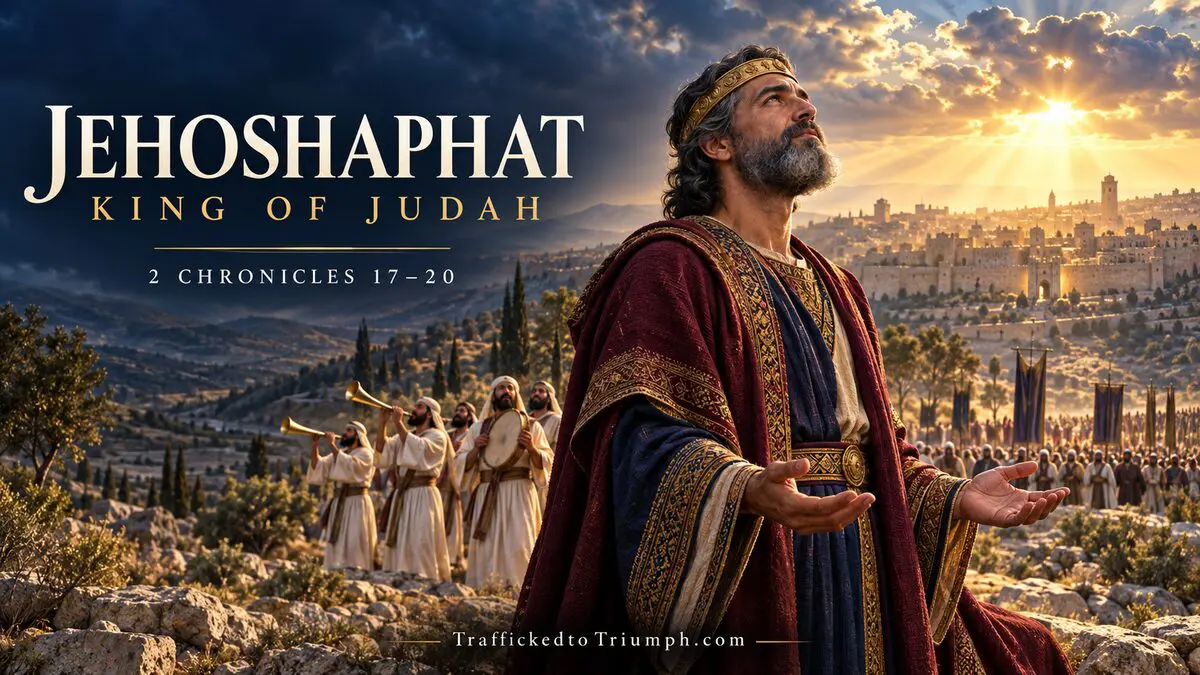
Jehoshaphat began his reign at age 35 and was on the throne for 25 years, from approximately 873 to 849 BC. He is best known for his religious reforms, military and political achievements, and his judicial reforms. His contemporaries ruling the Northern Kingdom of Israel were Ahab, followed by his sons Ahaziah and Jehoram. Overall, Scripture states that Jehoshaphat was a good king. We are not here to judge him, as we all fall short of the glory of God. But we can learn through the good and the bad.
Seeking God and Teaching the Book of the Law
2 Chron 17:3 states that the Lord was with Jehoshaphat as he walked in the former ways of his father David, not seeking the Baals. His heart delighted in the ways of the Lord (2 Chron 17:6), as he prepared his heart to seek God, emphasizing a heart directed toward God. (2 Chron 19:3) He continued the work of his father Asa in banishing the male shrine prostitutes, and in removing the high places and wooden images from Judah. (1 Kings 22:46) However, throughout his reign, the high places continued to be a recurring issue as the people’s hearts were not fully committed to following the God of their fathers. (1 Kings 22:43, 2 Chron 17:6, 2 Chron 19:3, and 2 Chron 20:33) In addition to these efforts to return the hearts of the people to God, he sent leaders throughout Judah, with the Levites and priests, to teach the people from the Book of the Law. (2 Chron 17:7-9)
How the Lord Established His Kingdom
He began his reign by strengthening himself against the Northern Kingdom of Israel by placing troops in all the fortified cities of Judah, setting garrisons in the land of Judah and in the cities of Ephraim, and building fortresses and storage cities. Because Jehoshaphat sought God, and not the Baals, walking in His commandments and not after the evil practices of Israel, the Lord established his kingdom. (2 Chron 17:4-5) And the fear of the LORD fell on all the kingdoms of the lands that were around Judah, so that they did not make war against Jehoshaphat, but instead gave him gifts and paid tribute. (2 Chron 17:10-11)
Jehoshaphat and Ahab: A Dangerous Alliance
Though he became increasingly powerful under God’s favor through covenant obedience, with riches and honor in abundance, the nation’s future of peace and stability under God’s covering was at stake; Jehoshaphat moved to ally himself with Ahab, king of Israel, whose reputation preceded him in corruption and apostasy through idolatry. This political move joined households through the arranged marriage of Athaliah, Ahab and Jezebel’s daughter, to his firstborn son Jehoram, who would be king after him. (2 Chron 18:1)
Jehu’s Rebuke and a Return to the Lord
Following a battle with King Ahab against Syria, that nearly cost Jehoshaphat his life, the Lord sent a message of rebuke to him: “And Jehu the son of Hanani the seer went out to meet him, and said to King Jehoshaphat, ‘Should you help the wicked and love those who hate the LORD? Therefore, the wrath of the LORD is upon you. Nevertheless, good things are found in you, in that you have removed the wooden images from the land, and have prepared your heart to seek God.” (2 Chron 19:2-3) Major reforms followed. “Jehoshaphat lived at Jerusalem. And he went out again among the people, from Beersheba to the hill country of Ephraim, and brought them back to the LORD, the God of their fathers.” (2 Chron 19:4)
Stand Still and See the Salvation of the Lord
Throughout his reign, Jehoshaphat publicly acknowledged God before battles and, in many areas, led by example in devotion to God. One such instance was recorded following the battle where he had partnered with Ahab, and where Ahab lost his life. In response to a massive three-nation army coming up against Jehoshaphat, he set himself to seek the Lord and proclaimed a fast throughout all Judah, in which all gathered to ask help from God. (Jehoshaphat’s moving prayer in the assembly is found in 2 Chron 20:6-12.) God honored him by moving mightily on his behalf, granting him great victory where all Jehoshaphat and his army needed to do was “stand still and see the salvation of the Lord”.
Faith in Crisis: Victory Through Praise
2 Chron 20:20-22 shows an example of his faith in crisis, “…. Jehoshaphat stood and said, ‘Listen to me, O Judah and inhabitants of Jerusalem, establish your faith in Yahweh your God and you will be established. Establish your faith in His prophets and succeed.’ When he had taken counsel with the people, he caused those who sang to Yahweh and those who praised Him to stand in holy attire, as they went out before the army, saying, ‘Give thanks to Yahweh, for His lovingkindness endures forever.’ When they began singing for joy and praising, Yahweh set ambushes against the sons of Ammon, Moab, and Mount Seir, who had come against Judah; so they were defeated.” And the fear of God came upon all the kingdoms of the lands when they heard that the LORD had fought against the enemies of Israel. Then Jehoshaphat’s kingdom was at peace, for his God had given him rest on every side. (2 Chron 20:29-30)
The Danger of Acting Presumptuously
One area that Jehoshaphat fell short was acting presumptuously, repeatedly joining in battle with those whose alliance the Lord had rebuked, needlessly placing himself in harm’s way. There is a danger in entering a battle, physically or spiritually, that we are not sanctioned to be in. Yes, he publicly acknowledged God and even asked for the word of the Lord from the prophets before battles in the presence of these pagan kings, but he seemed to expect God to protect him despite these persistent choices. A sobering example is found in 2 Chronicles 35:22–24 where righteous king Josiah, one whom Scripture states that there was not a king before or after like unto him, was killed in a battle that he was not called to be in.
His Greatest Mistake: Being Unequally Yoked
And though the Lord was very merciful towards him regarding, the greatest mistake was being unequally yoked, both politically and personally. Despite repeated warnings from the Lord, he continued the same pattern of compromise with not only Ahab, but also his sons, Ahaziah and Jehoram, telling them, “I am as you are, and my people as your people; we will be with you in the war.” We are advised in 2 Cor 6:14 (AMP), “Do not be unequally bound together with unbelievers [do not make mismatched alliances with them, inconsistent with your faith]. For what partnership can righteousness have with lawlessness? Or what fellowship can light have with darkness?”
Wrecked Ships and the Motives Behind His Alliances
Perhaps the following verses given in both accounts (1 Kings & 2 Chron) offer clues as to the motives behind the repeated alliances in question that seemed to defy every standard raised, as evidenced in nationwide reforms implemented to keep his kingdom grounded in their covenant relationship with the Lord:
“Later, Jehoshaphat king of Judah made an alliance with Ahaziah king of Israel, who acted wickedly. They agreed to make ships to go to Tarshish, and these were built in Ezion-geber. Then Eliezer son of Dodavahu of Mareshah prophesied against Jehoshaphat, saying, ‘Because you have allied yourself with Ahaziah, the LORD has destroyed your works.’ So, the ships were wrecked and were unable to sail to Tarshish.” (2 Chron 20:35-37)
“Jehoshaphat made merchant ships to go to Ophir for gold; but they never sailed, for the ships were wrecked at Ezion Geber. At that time Ahaziah, son of Ahab, said to Jehoshaphat, ‘Let my servants sail with your servants,’ but Jehoshaphat refused.” (1 Kings 22:48-49)
The Pursuit of Wealth Through Compromise
It appears he desired to follow in Solomon’s footsteps to acquire wealth. Same ships. Same port. Same destinations. (1 Kings 9:28, 1 Kings 10:22, 2 Chron 9:21) Wealth is not necessarily bad. But he was out of alignment with God, with whom he partnered, and discipline followed. While he seemed to take correction by backing off from his partnership with Ahaziah, he later allied himself with Ahab’s other son, who would rule after Ahaziah.
Perhaps covetousness seared Jehoshaphat’s conscience to the fear of the Lord and His warnings, blinding him to the devastating influence of idolatry through the joining of households. Ironically, he was known as the king who “made peace with the kings of Israel”. Peace at what cost? And what were the fruits of the pursuit of wealth through compromise? While he was correctly aligned with God, he was blessed abundantly.
The Cost of Compromise and the Rise of Queen Athaliah
In any case, by crossing the boundaries of covenant relationship with God through these ungodly partnerships and yoking his household to the corrupting influence of idolatry, his compromise would cost his household and kingdom dearly in the years following his death, with the slaughter of his 6 sons and later, even his grandchildren through the rise and reign of Queen Athaliah.
“For the love of money is a root of all kinds of evils, which some, stretching after, have been seduced away from the faith and have pierced themselves with many sorrows.” 1 Tim 6:10



Leave a Reply